| |
|
A Year in Review
Wallkill River Watershed Alliance Update
Celebrating 10 years of stewardship, advocacy, and community along the Wallkill
Authored by Robert Howe (WRWA Coordinator) and Martha Cheo (Head Chair Person)
|
|
The Wallkill River Watershed Alliance thanks all supporters who have contributed during
the first 10 years of the organization’s existence. The Alliance has accomplished
significant milestones with community support and continues this work into 2026.
Please consider supporting the Alliance by becoming a member or making a donation.
Memberships and donations are available on the website:
https://www.wallkillalliance.org/join/
The annual membership meeting is scheduled for Monday April 27th at 7:00 PM in an
in-person/hybrid format in the Gardiner or Montgomery area (location TBD). Board
elections are held that evening, and all members are eligible to vote and receive an
invitation to the meeting. The Alliance is also seeking candidates to fill vacant board
seats. Board and advisor meetings are held on the fourth Monday of each month at 7:00
PM,
usually on Zoom.
|
|
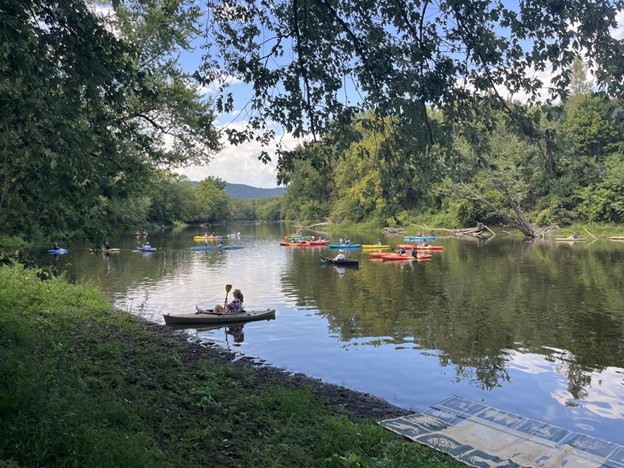
A season on the river: community, stewardship, and a decade of watershed work.
|
Upcoming Events & Opportunities
Spring 2026 — Save these dates and get involved
|
|
General Meeting
Annual Membership Meeting & Board Elections
Monday, April 27, 2026 — 7:00 PM
In-person/hybrid format — location TBD (Gardiner or
Montgomery
area)
Board elections are conducted, members connect with one
another, and membership renewal is available.
|
|
|
|
Volunteer Opportunity
HABs Volunteer Reporter Training
April – May 2026 — Virtual, ~3
hours
WRWA is organizing a DEC-led training so community members
across the watershed can officially report Harmful Algal Blooms
(HABs). No experience required. Reports will appear on both the
NY HABs DEC website and WRWA’s map in real time.
Interested participants may contact Bobby at
WRWA:
wallkillalliance@gmail.com
|
|
|
|
Volunteer Day
Trees for Tribs / Riverkeeper River Sweep
Saturday, May 2, 2026 — 10:30 AM to 2:30
PM
WRWA hosts a riverside cleanup and riparian restoration event in
partnership with Riverkeeper’s annual River Sweep.
Volunteer shirts provided. More details coming soon.
|
|
|
|
Community Art & River Engagement
Wallkill Futures — NEA-Funded Community Events
May through August 22, 2026
A National Endowment for the Arts-funded program bringing
community-engaged art to the Wallkill. Activities begin in May
and culminate in an exhibition at Unison Arts, July 17
– August 22. Includes floating wetland
installations, river trash printmaking, nature painting,
live-action-role-play performances on the riverside, and the
launching of ‘Future Water Commons’ on the Wallkill
–
an 8×20 foot vessel showcasing the ecological importance of the
river. Volunteer and
participation opportunities are announced throughout the season.
|
|
|
Looking Ahead
Annual Membership Meeting
Monday, April 27th, 7:00 PM —
In-person/hybrid
Board elections will be held, and members are eligible to vote.
Monthly Board and Advisor Meetings
Fourth Monday of the month,
7:00
PM, usually on Zoom
Board Service
The Alliance is looking to fill vacant board seats
and welcomes suggestions.
|
Get Involved
Memberships and donations support watershed projects and community-based
monitoring efforts planned for the Shawangunk Kill Watershed.
Questions or partnership inquiries:
wallkillalliance@gmail.com

Scan to join or donate
|
|
Follow WRWA on social media
|
|
|
|
|
Current Work in 2026
HABs:
The WRWA is working with Riverkeeper, Hudson River Watershed Alliance and Bard College
on developing a Harmful Algal Bloom (HAB) “Communications Tool Kit and Framework” for
the Wallkill River, with the goal of coordinating effective public communications about
HABs and other emergency conditions that affect public health.
The new Coordinator/Administrator, Bobby Howe, will take the lead on this project, as
he is also working on a Master’s Thesis at Bard focusing on HABs. His research pilots
ECO HABIT (Educational Community Outreach, Harmful Algal Blooms Information Tracker),
an interactive web platform that trains community members to identify and report toxic
cyanobacterial blooms integrating real-time station monitoring, creating a
scientifically rigorous early warning system.
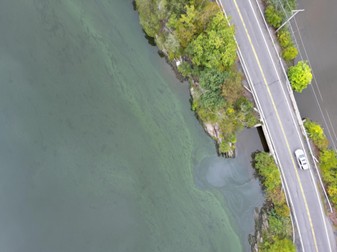
Last year 9 total blooms were reported in the watershed on the DEC’s NYHABS system,
with 3 intermittent reports on the River in August, and Sturgeon Pool experiencing a
persistent event with 6 confirmed reports from September through October.
Harmful algal bloom conditions in the Wallkill watershed.
NYS DEC Clean Water Plan for the Wallkill
HABs can result from a combination of factors, including excessively hot and dry
weather, lack of flow due to dams, and nutrients entering the river from human
activities. The NYS DEC is in the process of developing a Clean Water Plan for the
Wallkill, focused on the inputs of one nutrient, phosphorus. The plan will identify
and quantify sources and amounts of phosphorus entering the river, establish a limit
(Total Maximum Daily Load – TMDL) and identify ways to reduce the loading to meet that
limit. We hope that this plan will result in projects being prioritized for Federal and
State funding in the future. This is a several year process but we look forward to
working with the DEC to share the plan with the watershed community when it is ready
for public input. In the meantime, we can all be aware of our role in protecting the
Wallkill by minimizing our use of, and properly disposing of, household chemicals,
maintaining proper functioning of septic systems, maintaining native vegetation as
buffers along waterbodies, reducing runoff from our properties, and limiting pesticide
and fertilizer use.
Shawangunk Kill Watershed Environmental Benefit Project:
Hudsonia Ltd., will be working with the Alliance to complete a Watershed
Characterization Report for the Shawangunk Kill based on an assessment of current
water quality and watershed conditions, including stream biological and chemical
parameters as well as important habitats along the main river floodplain. The project
also includes a freshwater mussel survey conducted by Andrew Gascho-Landis of SUNY
Cobleskill. We will be looking for interested residents in the watershed who would
like to help with the stream sampling and habitat assessments. We will also be
looking for volunteers to serve on a Shawangunk Kill Watershed Characterization
Advisory Committee, to provide local knowledge, data, guidance on characteristics
important to communities in the watershed, and oversee the next steps of developing a
Watershed Plan. The Alliance will also convene a Shawangunk Kill Summit to present
the results of the assessments and characterization and facilitate discussion on how
the watershed community can use this information to protect the health of the
watershed into the future.
|
Alliance on the Wallkill in a Glance: 2025 Summary
Organizational Capacity Building:
In 2025 we participated in an Organizational Capacity Building Program with Hudson
River Watershed Alliance. Through this program we developed a Strategic Work Plan for
the coming year and adopted an improved fiscal tracking tool. We gained two new board
members, Mark Palczewski and Karina Tipton, both on the Town of Montgomery
Conservation Advisory Council, and hired a part time coordinator/administrator, Robert
Howe, a graduate student at Bard working on HABs. We will also be working with a web
consultant to upgrade our website.
Community Outreach:
- Board and Advisory Members of the WRWA spent hundreds of
volunteer hours participating in numerous watershed-related meetings and events,
such as: the Hudson River Watershed Alliance Conference, roundtables and trainings;
Riverkeeper Water Quality Monitoring Collaborative Workshop, NYS Department of
Environmental Conservation trainings, presentations and meetings; Ulster County
Environmental Management Council meetings; Mohonk Preserve stream sampling; NYS
Association of Conservation Commissions conference, New Paltz Earth Day Fair,
Wallkill High School Duck Derby; and various town and village board meetings.
- On Nov. 6, WRWA hosted an informational dinner meeting at City Winery in
Montgomery. More than 20 people attended a presentation on past and current WRWA
activities, followed by a productive round-robin discussion of participants’
interests and visions for the Wallkill. Many attendees have contributed important
work on behalf of the watershed.
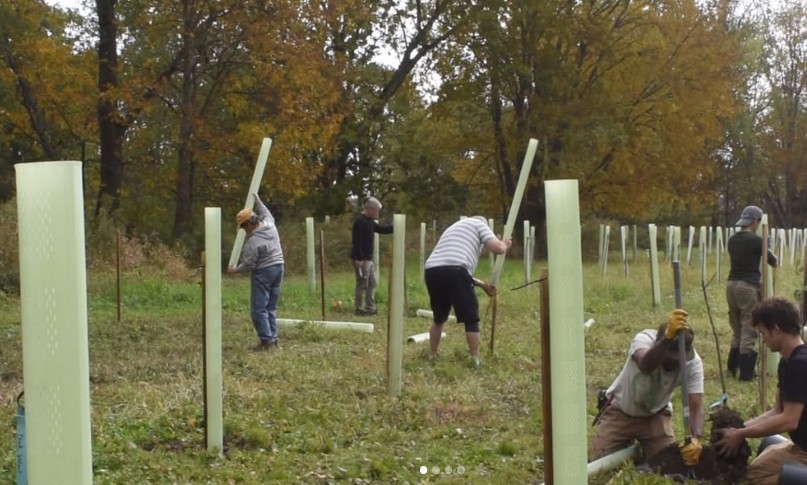
Trees for Tribs:
In conjunction with Riversweep, the Alliance hosted a day of planting and maintaining
riparian trees at the Trees for Tribs planting site in New Paltz on the River along
the OSI
River to Ridge trail in early May. WRWA helped recruit volunteers to assist with
planting hundreds of trees at Conuco Organic Farm along the Wallkill River in New Paltz
in May and again in October. The Montgomery CAC continued to maintain their 10-year-
old Trees for Tribs plantings along the Muddykill and the Wallkill at Benedict Farm
Park. This summer they participated in a NYS Water Resource Institute acoustic study to
determine bird biodiversity. The study identified 52 different bird species, including
two — the Chimney Swift and the Field Sparrow — that have declined
significantly on a
continental scale.
|
Music on the Wallkill Paddle Event:
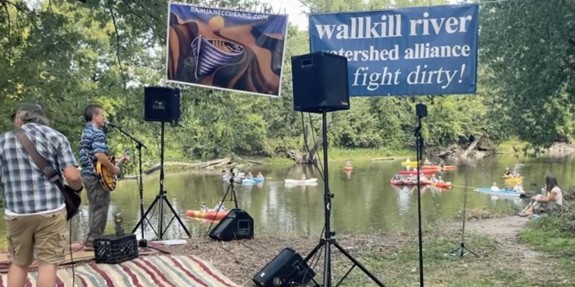
On Sept 14 the Alliance hosted this successful event with over 40 attendees, most
attending by kayak on the river and a few by land. Paddlers launched at Sojourner Truth
Park and
enjoyed music from the river courtesy of the Damian Ecco Band, who were perched on a
spot overlooking the river on the River-to-Ridge Trail in New Paltz.
|
A Closer Look: Black Dirt Rewetting
Project Overview:
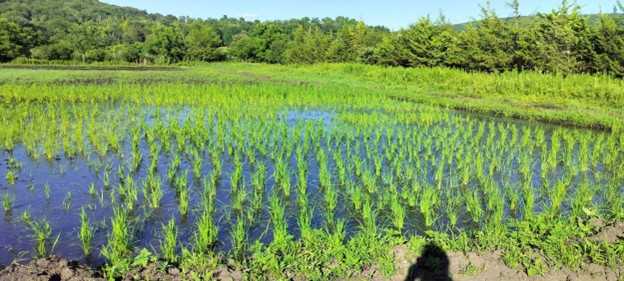
WRWA Board Member Orion Russell Blake has been working to promote the wise use of
peatlands locally, the largest of which is the Upper Wallkill’s farmed floodplain
known as the ‘Black Dirt Region’. He is pursuing paludiculture, starting with a rice
paddy at the headwaters of the Wallkill’s Wawayanda tributary, on the same parcel
“Sugar” the mastodon (on display at SUNY Orange) was excavated from. Paludiculture,
a sustainable agricultural practice on rewetted peatlands, is a significantly
climate-friendly approach because wet peatlands are hugely efficient carbon sinks,
while drained peatlands emit high amounts of carbon dioxide.
Paludiculture is more developed overseas, and this year Orion went to both “The
Fens,” a peatland that grows a third of England’s produce, and to the German center
that coined the term. While on the continent, he also visited the Wallkill’s namesake,
the “Waal River,” a main branch of the Rhine River and an important waterway in the
Netherlands both currently and historically.
|
Research and exchange: Paludiculture is more developed
overseas. This year, Orion visited “The Fens” (a peatland that grows a third
of England’s produce) and a German center that coined the term. While on the
continent, he also visited the Wallkill’s namesake, the “Waal River,” a main
branch of the Rhine.
|
|
|
Wallkill River Watershed Alliance
Support ongoing watershed work:
wallkillalliance.org/join
Learn more:
wallkillalliance.org
Contact:
wallkillalliance@gmail.com
Facebook:
https://www.facebook.com/wallkillriver/
Instagram:
https://www.instagram.com/wallkillriverwatershedalliance/
|
|